
The San Luis Directory Shelf
The strongest verified San Luis city directory source is the Yuma City Directories collection in the Arizona Memory Project. Its 15 online volumes cover 1948, 1949, and each year from 1951 through 1963. The books are countywide. A San Luis resident may appear beside entries for Somerton, Roll, Tacna, Wellton, Bard, or another Yuma County community rather than in a stand-alone San Luis volume.
| Historical source | Verified span | Repository | How to use it |
|---|---|---|---|
| Yuma City-County and Cosmopolitan directories | 1948, 1949, 1951-1963 | Arizona Memory Project | Free PDF and OCR search |
| Yuma newspapers | 1872-2011 aggregate | Arizona Room | Room-use microfilm with staff help |
| Arizona census reels | 1880, 1910, 1920 | Arizona Room | Library research |
| San Luis clipping files | 1956-1988 and 1990-2012 intervals | YCLD Ephemera Collection | Request by place, topic, and year |
| Gadsden school registers | 1970-1979 | Genealogical Society finding aid | Ask staff about access limits |
No 1950 item appeared in the inspected digital run. Nor did the research locate an official catalog proving later San Luis-specific books or a complete sequence of reverse directories. Treat the verified online dates as firm and all broader shelf claims as questions for Special Collections.
Fifteen San Luis Directory Volumes
The 1960 catalog record names Yuma Directory Co. as publisher. It identifies a county directory covering San Luis and other communities, with call number 917.91DC Y959 [year] and OCLC 18176725. FamilySearch International digitized that volume in 2019 for the State of Arizona Research Library. That shift from a shelf book to a free searchable PDF is a key point in the local directory story.
OCR, or optical character recognition, turns the scanned page into searchable text. It saves time, but it is not a true index. Old type, short place codes, faint pages, and Spanish compound surnames can all confuse it. Search the PDF first, then browse the alphabetical pages around any hit. Manual inspection often finds a name that a text search missed.
| Confirmed volumes | 1948, 1949, and 1951 through 1963 |
|---|---|
| Known gap | No 1950 volume appeared in the inspected results |
| Digital format | Scanned PDF with OCR text |
| Geographic scope | Yuma County communities, including San Luis |
Note: A missing OCR hit is not proof that the person or San Luis household was absent from the printed directory.
Decode San Luis Directory Entries
The inspected 1962 volume uses compressed lines. An entry may combine surname, given name, spouse, household count, work, home or room address, telephone number, and a PO box. The letters h and r mark home and residence or rooming addresses. Common short forms include emp for employed, ret for retired, studt for student, carp for carpenter, dom for domestic work, and drvr for driver.
| Name line | Surname and given name, sometimes with spouse in parentheses |
|---|---|
| Household clue | A numeral after the spouse may reflect children or household count; confirm in that volume's key |
| Work clue | Short occupation or employer wording |
| Place clue | Street address, residence marker, phone, PO box, or shortened community name |
| Institutional line | A public office or business entry rather than a household |
- Criss-cross directory
- A directory arranged by street or telephone number instead of only by surname.
- Householder index
- A name list tied to the person listed for a household, not a census of all occupants.
- Abbreviation key
- The publisher's legend for short forms. Read it before expanding any code.
San Luis Directory Place Labels
A countywide volume asks more of the reader than a city-only book. The 1962 volume shortens some community names and sometimes relies on PO boxes. One institutional line identifies the United States Post Office at San Luis and names Lillian M. Verdugo as postmaster. That line documents a local institution, but it does not imply that all San Luis households received a street listing.
The border creates another trap. “San Luis” without a state or country can mean the Arizona city or San Luis Río Colorado in Sonora. Add “Yuma County” and “Arizona” to catalog searches. Within a PDF, try the city name, a surname, a phone number, and likely short forms. Search each part of a compound surname on its own, both with and without accents.
San Luis City Directory OCR
Catalog OCR has rendered San Luis as “San Luise.” That small error is a useful warning. Search spelling variants instead of trusting one query. Reverse the given-name and surname order. Remove an accent for one pass, retain it for another, and search both parts of a two-surname name. A spouse or business name may reveal the right line when the main surname does not.
The same care applies to dates. A person who appears in one volume and vanishes in the next may have moved, died, changed listing name, switched to a PO box, or simply gone unlisted. The annual sequence narrows the window. It does not explain the event on its own.
Local growth can also distort a quick comparison. San Luis was founded around the port in 1930 and incorporated in 1979, long after Yuma County record systems began. Early residents may be described by a county, agricultural camp, Gadsden Valley, or postal label instead of the later city heading. Search those geographic forms before deciding that the shelf has no trace. A county directory line may be the right record even when the page never spells out the modern city name.
San Luis Directory Library Sources
The Arizona Room at Yuma Main Library holds the deeper newspaper, census, and local-history material. It is on the second floor, with help available at 928-314-2463 or SpecialCollections@yumalibrary.org. Newspaper holdings include Early Newspapers from 1859-1936 and named Yuma newspaper runs from 1935 through 2011. These sources can explain an address change or add an obituary, civic event, or business context to a directory entry.
The Yuma County Library genealogy resources also point researchers to Ancestry Library, Fold3, HeritageHub, and HeritageQuest under their stated card or in-library rules.
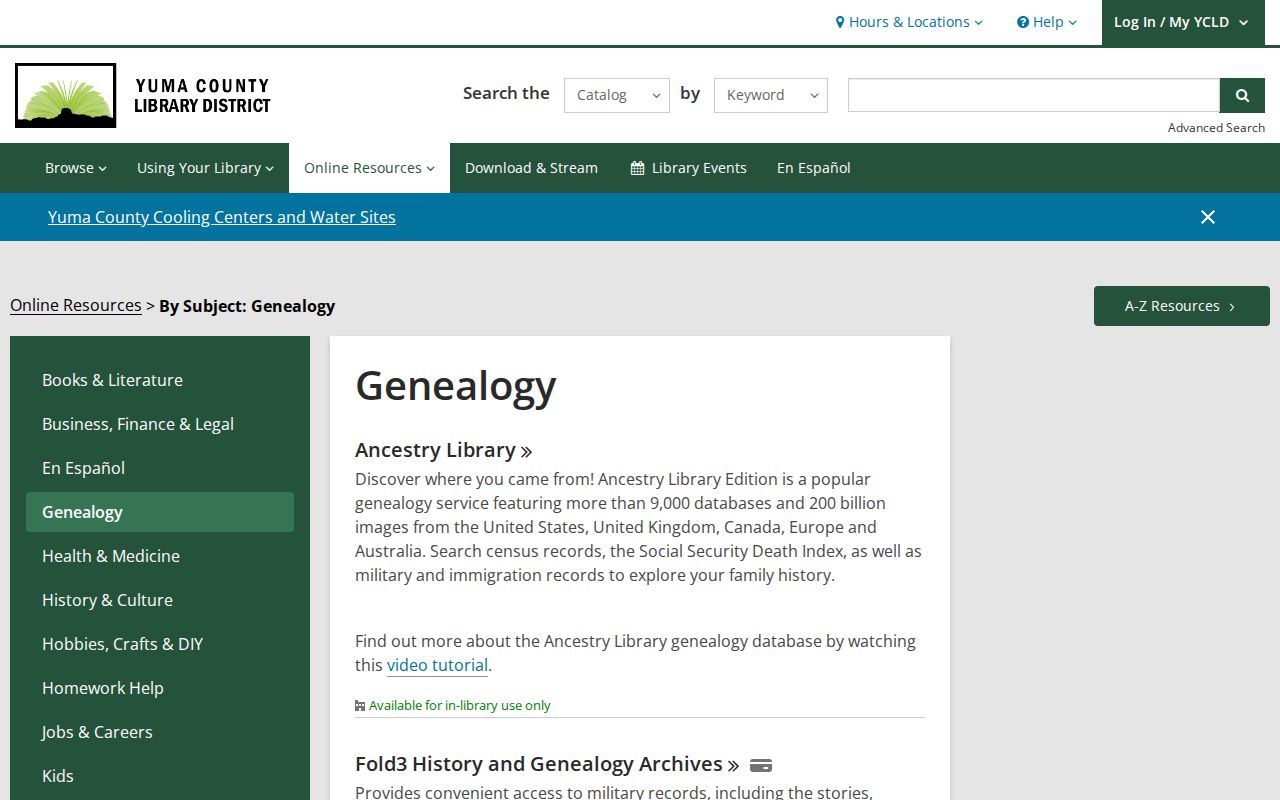
The captured library page shows why the historical search does not end with the directory PDFs. Census, military, obituary, and family-history databases offer independent checks for the same San Luis name.
The YCLD Ephemera Collection adds San Luis clipping folders from 1956-1988 and shorter yearly spans through 2012. Ask for a folder by place, topic, and year. That request is more precise than asking staff to search every clipping for a common surname.
Trace San Luis Directory Households
Historical directories are strongest as a sequence. Record the exact printed form of the name, spouse, work, phone, place code, address, and box number. Then move one volume at a time. A first or last appearance brackets change far better than a jump of ten years.
- Start in the alphabetical section with every meaningful surname form.
- Copy the full entry and the volume year, including all short forms.
- Check the next and prior volumes for the same household clues.
- Use a street or reverse section if that specific volume contains one.
- Pair the trail with the public 1950 census, deeds, probate, newspapers, or an obituary.
The 72-year federal census rule makes 1950 the latest public decennial census as of 2026. The 1960 census is not yet open. That makes the directory run especially useful between the public census year and later local records. Modern address-keyed searching belongs in the San Luis street directory, while the historical volumes remain the right place for the older household sequence.
When a name drops out, test the newspapers and clipping files for a death, move, marriage, business change, or civic notice. Deeds can connect a surname to land, while probate can identify heirs. School registers may support a family link only when staff confirms lawful access. No single source should carry the full conclusion, especially when common surnames or a missing second surname create two plausible matches.
San Luis Directory Gaps
Some San Luis lives will not appear on the historical shelf. The Arnold Cordova Jr. City Library preserves the migrant-worker oral-history and photo project “San Luis Takes Its Place in Arizona's History.” Its accounts cover migration, irrigation, farm work, sharecropping, and family settlement. These narratives add human context to residents whose lives may not be visible through land ownership or a street listing.
The Genealogical Society finding aid points to Gadsden School District registers from 1970-1979, church and family files, diaries, scrapbooks, cemetery records, yearbooks, and legal or military papers. Student material may have access limits, so ask Special Collections rather than assuming every register is open. The San Luis clipping files and small manuscripts, including Frank Loya's 1942 history, provide other routes around a directory gap.
For federal and Indigenous research, National Archives at Riverside holds Arizona land, court, naturalization, tax, and agency series. Fort Yuma Agency files include a birth and death register plus school censuses, while Colorado River Agency holdings include census, health, and welfare material. These are specialized sources, not a general San Luis resident roll.
Note: Directory books are publisher-made snapshots, so corroborate every family-history conclusion with at least one independent source.