
San Luis Resident Lookup Sources
One-person research begins by deciding what must be proved. The Yuma County Assessor can tie an owner to a parcel, but it cannot name each person who lives there. A recorded deed supplies a transfer and a legal description. Arizona court indexes connect a party to a case, while vital records support family and life-event facts. A San Luis resident lookup becomes sound only when the source matches the claim.
| Record | Fact It Can Confirm | Custodian or Portal | Access Route |
|---|---|---|---|
| Property roll | Owner, tax mailing destination, parcel and situs | Yuma County Assessor EagleWeb | Free guest search |
| Recorded documents | Transfer, name variant and legal identity | Yuma County Recorder | Online index or counter |
| Court index | Party, case type, filing and docket events | Arizona Public Access and court clerk | Free index; documents vary |
| Vital records | Birth, death, marriage or divorce facts | ADHS, Archives or Yuma clerk | Eligibility and age rules apply |
| Business and license files | Named public role, status and business contact | ACC or the relevant state board | Public portal or agency search |
Start with the strongest known key. An address points first to EagleWeb. A case number points to the court. A deceased relative may lead to probate, an obituary, or an archival certificate. Business contacts are leads, not proof of a home address. Voter status is not a general public name search, so it should never be used as a shortcut around Arizona's access limits.
Check San Luis Resident Court Results
The Arizona Public Access Case Lookup covers most Arizona courts and is updated weekly. Search by case number or by first and last name or business name. Where offered, a birth date and court or county filter help separate people with similar names. A verification text field must also be completed. San Luis Municipal Court, South County Justice Court, and Yuma County Superior Court may each hold a different part of a person's court trail.
A public result can show the case number, court, case type, filing date, party role, public charge or citation, status, disposition, and docket events. It may omit sealed cases, orders of protection, mental-health matters, juvenile matters, and other protected facts. Public Access is a discovery index, not the official file.
The Arizona eAccess court document portal shows how a party search leads into case details and available documents.
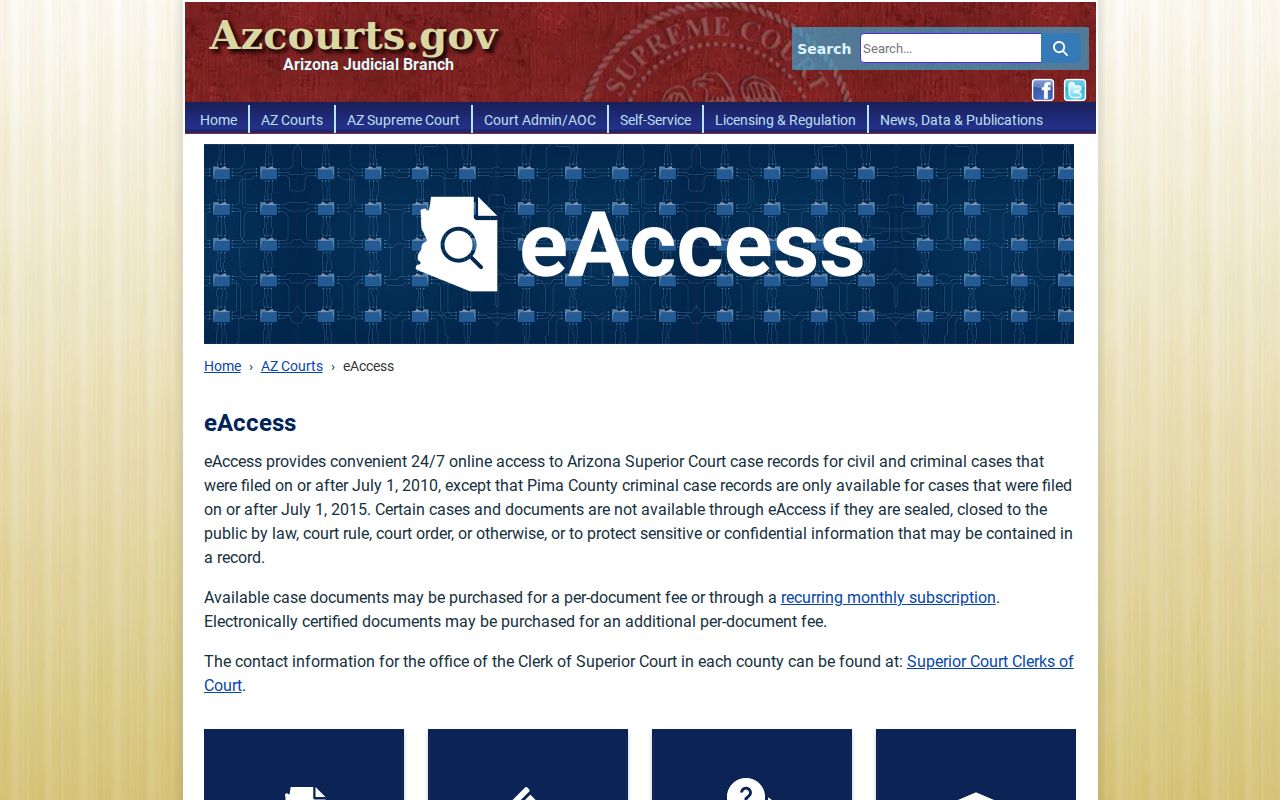
The account-based screen supports party or case searches, court selection, case-detail views, exports after verification, and document purchase for eligible Superior Court files. If a result matters, ask the court of record for the controlling copy.
Match the Right San Luis Resident
San Luis names often appear with accents, hyphens, compound surnames, shortened given names, or a dropped second surname. An index may reverse name order. Older optical character recognition can also distort a spelling. Run each meaningful surname by itself, try the accented and plain forms, and retain every middle initial. A failed search calls for a new method, not a claim that no record exists.
Use at least two independent identifiers before combining results. A matching APN or legal description is stronger than a city name. A spouse, birth year, case number, instrument number, or license number can separate two people who share a name. The San Luis resident lookup should preserve the query spelling, date checked, URL, and record identifier so the match can be reproduced without saving excess private data.
Note: “San Luis” must be qualified with Arizona or Yuma County so results from the same-named Sonora city do not get mixed in.
Verify a San Luis Resident Record
Use a short chain that moves from a broad index to the official custodian. It keeps a resident lookup focused on one person and reduces the risk of joining unrelated files.
- Normalize the full name. Search compound surnames, accent variants, and known middle initials as separate queries.
- Anchor the person to a stable fact. In EagleWeb, compare the owner mailing address, parcel number, situs address, and legal description without treating ownership as occupancy.
- Search Arizona Public Access by name, then narrow to the relevant court. Compare case number, party role, filing date, and any lawful identifying facts.
- Use a vital index, probate file, deed, license number, or entity role as a second source. Do not infer a family link from a shared surname alone.
- Request the official document from the assessor, recorder, court clerk, vital-records office, or other custodian when proof is needed.
- Docket
- The ordered list of filings and events in a court case.
- Index versus image
- An index points to a record; the image contains the filed document and may require a login, fee, or clerk request.
- Certified copy
- A copy authenticated by the office that keeps the original record.
- Situs address
- The parcel's physical tax location, which can differ from the owner's mailing destination.
San Luis Resident Vital Record Paths
Birth and death records follow different rules from marriage and divorce files. The Arizona Department of Health Services Bureau of Vital Records and Yuma County Vital Statistics issue recent certified birth and death copies to eligible applicants. Birth certificates transfer to the State Archives after 75 years and death certificates after 50 years under A.R.S. §36-351. The archival opening does not remove eligibility rules from a recent certificate.
Yuma County Vital Statistics accepts local requests at its Yuma office, while current state forms govern identity and relationship proof. Marriage licenses and divorce decrees stay with the Yuma County Clerk of Superior Court. A case index can point to a divorce file, but it is not the decree. When civil registration is too early or restricted, the Arizona Room's newspapers, church materials, cemetery sources, and genealogy databases can supply careful leads.
Find San Luis Heirs Lawfully
Probate, deeds, and obituaries form a useful personal trail when a family must identify an heir or reconnect after a death. Begin with a known decedent and search Yuma County probate by name and approximate year. Record the case number and the titles of public petitions or notices. Then compare the parcel's legal description and the names on later deeds. An obituary may provide relationship clues, but each link should be checked against a court or vital record.
Birth-family research involving sealed adoption files has its own lawful route. Arizona's Confidential Intermediary Program uses court-certified intermediaries and court orders to search sealed court or agency records. Consent rules control identifying contact. The program serves eligible adult adoptees, certain adoptive and birth relatives, and specified relatives of a deceased adoptee or birth parent. It is not an ordinary resident lookup and should not be bypassed through open indexes.
Confirm San Luis Business Connections
A business role can distinguish one San Luis resident from another with the same name. The Arizona Corporation Commission entity search accepts an entity name, statutory-agent name, principal name, or entity ID, with optional type, status, name-type, and county filters. A profile may show entity status, formation date, known place of business, public agent or principal details, and filing history.
State licensing boards add credential number, status, dates, and public discipline where available. San Luis License and Tax keeps city business-license records, but its renewal screen requires notice credentials and is not a public licensee index. Ask the City Clerk for a defined register extract when needed. A statutory-agent office, principal address, firm address, or license contact proves an affiliation. None proves where the named person lives.
San Luis Lookup Source Hierarchy
Commercial compilations can merge public and private feeds, repeat stale addresses, and attach the wrong person to a phone or relative. Treat that category only as an unverified lead. A resident lookup gains weight as it moves closer to the custodian.
| Source Level | Best Use | Core Limit |
|---|---|---|
| Commercial compilation | Possible spelling or old-location lead | Source and update date may be unclear |
| Official public index | Find a case, parcel, filing, or instrument number | May be delayed, partial, or omit the document image |
| Custodian file | Verify the official record and obtain a copy | Redaction, eligibility, fees, and access rules apply |
The official record and current signed form control disputed facts. If an index is wrong, contact the office that owns that series and cite the exact case, instrument, parcel, entity, or license number. A broad name-only correction request is less useful.
Request Missing San Luis Resident Files
An online miss is not the end of the search. San Luis Municipal Court accepts a written request that identifies the plaintiff or defendant, date of birth, case details, and the desired complaint, plea, sentencing paper, protection order, complete file, or other item. A requester may ask to view the file or receive copies, audio, or certification by pickup, fax, email, or mail. The current form states a 5 to 7 business-day process, a $17 minimum clerk fee, $0.50 per page, and added charges for audio or certification. Sealed, confidential, or purged files remain unavailable.
Superior Court probate, family, and older matters go to the Yuma County Clerk with a party name, case number when known, approximate year, and document title. City administrative records use the San Luis City Clerk request process, while police records go to the Police Records Division. Under Arizona Public Records Law, ask the right custodian for a named series, date range, person, address, and preferred format. The law requires prompt handling but sets no single day count for every request.
San Luis Resident Lookup Limits
Arizona Public Records Law opens many government files to inspection, but statutory and privacy exceptions remain. Recent vital records require eligibility. Sealed and juvenile court files stay closed. Voter files are restricted by A.R.S. §16-168, and the public self-service voter portal is an identity-gated status tool rather than an open directory. The Arizona Address Confidentiality Program can substitute an address for eligible protected people, so a missing location may be deliberate and lawful.
The successful manifest image below comes from the Arizona Department of Public Safety offender information page, an official public-safety source with its own stated limits.
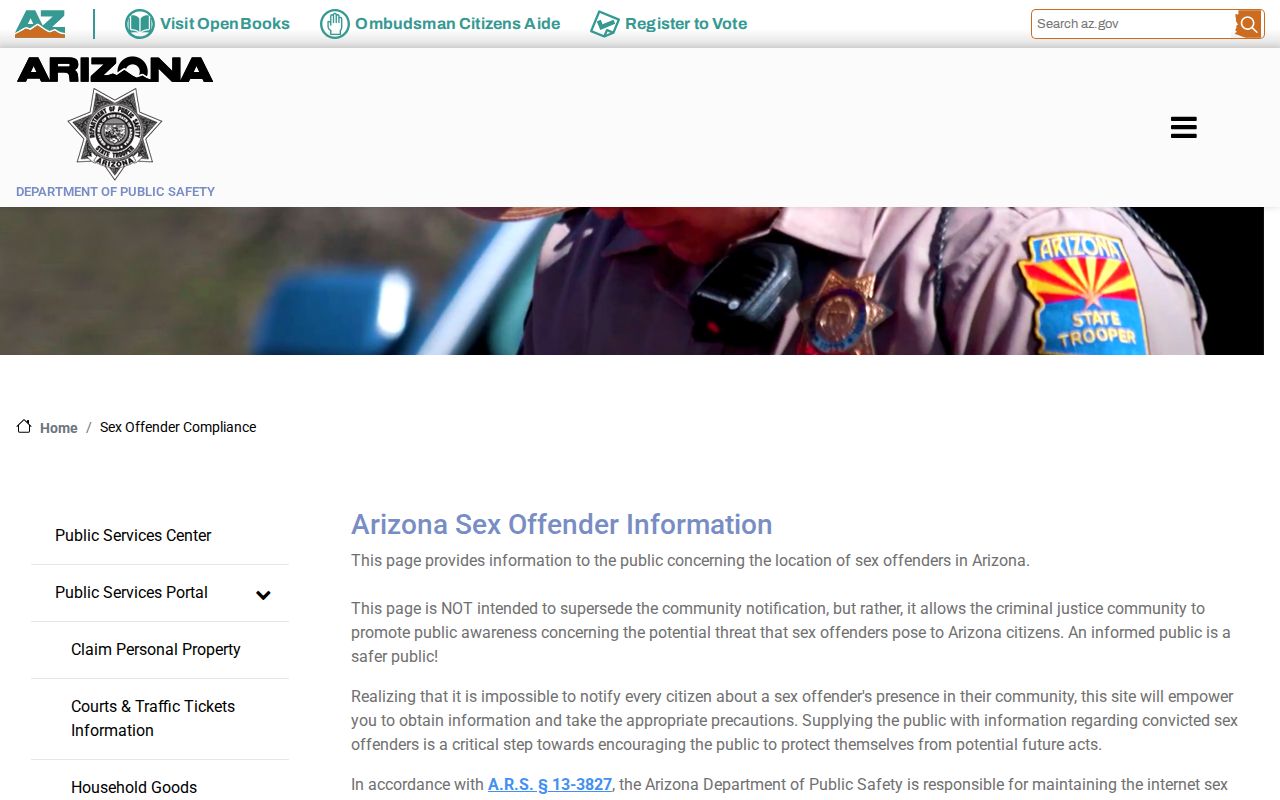
Such a result must be read only for the purpose and facts the agency publishes. It is not a general identity profile and does not replace a court record.
Lawful use. A San Luis resident lookup supports personal research, family reconnection, and fraud checks. Arizona law does not permit stalking, harassment, threats, or intimidation.